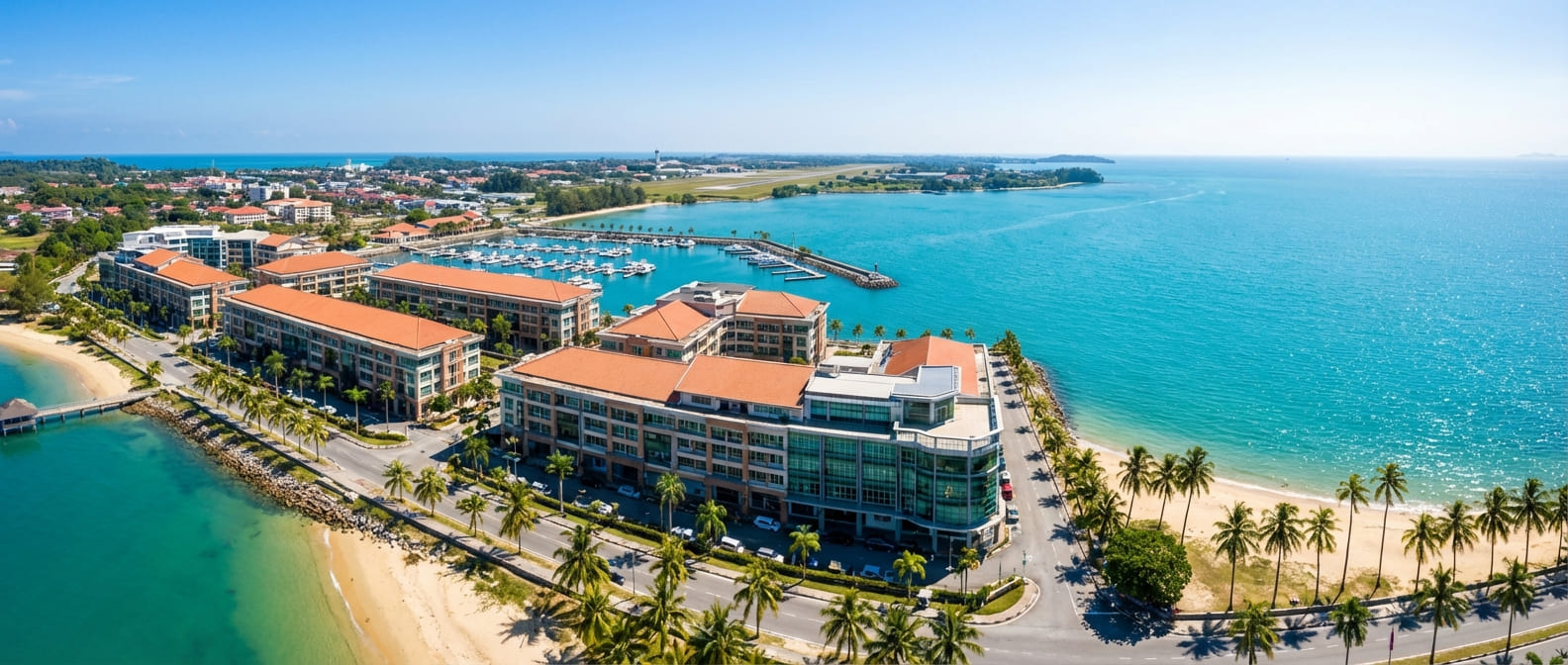

Overview
Labuan is Malaysia's International Business and Financial Centre (IBFC), regulated by the Labuan Financial Services Authority. Crypto and digital-asset activities are authorised as Digital Financial Services (DFS) under the Labuan Financial Services and Securities Act 2010 (LFSSA), with detailed expectations set out in the 2023–2024 Labuan FSA guidelines: Market Conduct for Labuan Digital Financial Intermediaries (20 Dec 2023), Credit Token Business (26 Jun 2024), Red Flag Indicators (24 Jun 2024) and the Admissibility Framework for Digital Currencies (final, 30 Dec 2024).
The economics: MYR 500k paid-up, 3% trading tax on net audited profits, real substance, adequate full-time employees in Labuan, minimum annual operating expenditure on the island, and a physical office. Failure to meet substance moves the entity to the standard Malaysian 24% rate.

The regulator. Labuan FSA
Labuan FSA was established in 1996 under the Labuan Financial Services Authority Act 1996. It is the statutory regulator of the Labuan IBFC and operates the licensing, supervision and AML/CFT regime for all Labuan-licensed entities. Crypto-relevant guidance comes mainly from the Banking and Other Businesses divisions, with the statutory base in the Labuan Financial Services and Securities Act 2010 and the Labuan Companies Act 1990. AML/CFT expectations are published in the Labuan FSA regulatory framework. The 3% LBATA rate is administered through LHDN Labuan, while domestic Malaysian company-law touchpoints are handled by the Companies Commission of Malaysia (SSM).
Licence types
| Licence | Statute | Min paid-up capital |
|---|---|---|
| Money-Broking Licence with virtual-currency endorsement | LFSSA Part VI (ss. 90 & 92) | MYR 500,000 |
| Credit Token Business | LFSSA s.129 | Risk-based (per 2024 guidelines) |
| Digital Exchange / DFS Intermediary | LFSSA + DFS Guidelines | Risk-based, typically above statutory minimum |
Labuan FSA applies risk-based capital: for DFS or virtual-currency business the practical expectation is above the statutory minimum to meet Technology Risk Management obligations. The exact uplift depends on business model, transaction volume and custody arrangements. Under the September 2024 Money-Broking Guidelines, Labuan FSA may exercise discretion to require additional capital commensurate with the business risk profile.
Activities allowed and excluded
The scope of a Labuan DFS authorisation is defined by the licence class and the underlying Labuan FSA DFS framework. A Labuan-licensed entity can carry on the activity in its licence endorsement and nothing else without prior Labuan FSA approval.
- Permitted under a Money-Broking (virtual-currency) Licence: brokerage and order-matching between counterparties, spot exchange of fiat-to-virtual-currency and virtual-to-virtual pairs, and client onboarding with non-Malaysian residents.
- Permitted under the Credit Token Business regime (s.129 LFSSA): issuance and administration of credit tokens, including payment tokens that represent stored value, in line with the Guidelines on Credit Token Business in Labuan IBFC (26 June 2024).
- Permitted under the DFS Intermediary / Digital Exchange track: operation of an exchange venue, custody of client digital assets, and token-admission processes aligned with the Admissibility Framework for Digital Currencies (30 December 2024).
- Excluded without further authorisation: servicing Malaysian residents (the domestic DAX route sits with the Securities Commission Malaysia), Islamic/Shariah-compliant products outside LIFSSA authorisation, deposit-taking under banking legislation, and dealing in capital-markets products outside the LFSSA scope.
- Conditional activities: staking, yield and lending products require Labuan FSA no-objection and alignment with the Red Flag Indicators Guidance Note for Labuan Digital Financial Services (24 June 2024).
The listed-token admissibility file, which digital currencies the licensee will list, and under what criteria, is reviewed both at application and on an ongoing basis under the 30 December 2024 Framework. A change of listed perimeter is a material change that must be notified to Labuan FSA.
Substance and entity requirements
Under the LBATA Substance Regulations 2018 (P.U.(A) 423/2018, as amended) a licensed entity must satisfy:
- Incorporation as a Labuan company under the Labuan Companies Act 1990.
- An adequate number of full-time employees in Labuan, typically 2 to 4 for DFS or credit-token business.
- A minimum annual operating expenditure in Labuan (typical range MYR 50,000 to MYR 200,000 depending on activity; verify the current P.U.(A) gazette for precise threshold).
- A physical, operational, equipped office on the island.
High-level checklist
- Incorporate a Labuan company under the Labuan Companies Act 1990.
- Confirm physical office in Labuan (Labuan Financial Park or equivalent) and recruit local full-time employees.
- Pay up share capital to MYR 500,000 (Money-Broking) or risk-based amount (Credit Token / DFS).
- Fit-and-proper directors, key management and substantial shareholders.
- AML/CFT programme aligned with Labuan FSA AML/CFT/CPF guidelines and the 2024 Red Flag Indicators Guidance.
- Technology Risk Management framework covering custody architecture and operational resilience.
- Token-listing and admissibility framework aligned with the 30 Dec 2024 Admissibility Framework for Digital Currencies.
- Three-year business plan, financial projections, AML/CFT risk assessment.
- File application with Labuan FSA via the relevant business division; respond to clarification rounds.
- Post-licensing: annual audited accounts under LBATA, periodic Labuan FSA returns, ongoing substance certification.
Process and timeline
| Stage | Money-Broking (VC) |
|---|---|
| Entity incorporation, substance setup | 1–2 months |
| Application preparation. AML, tech, capital | 2–3 months |
| Labuan FSA review | 3–6 months |
| Total realistic | 5–10 months |
Corporate banking and custody accounts
A Labuan-licensed DFS entity opens fiat operating accounts through Labuan IBFC banking partners and selected Malaysian-mainland and regional banks. Fiat rails sit inside the Malaysian banking ecosystem, and non-MYR flows can be held with correspondent banks outside Malaysia. Onboarding is a separate process from Labuan FSA licensing and runs in parallel from month three onwards.
Client-asset segregation is a condition of the licence. Fiat client monies are held in designated client accounts with a Labuan or Malaysian bank; virtual-asset client balances are held in custody wallets with clear segregation from house balances, with cold-storage architecture documented in the Technology Risk Management file submitted to Labuan FSA. Correspondent relationships typically require evidence of real Labuan substance, a clean AML/CFT programme aligned with the Anti-Money Laundering, Anti-Terrorism Financing and Proceeds of Unlawful Activities Act 2001, and an operational board presence in Labuan.
Taxation under LBATA
- Labuan trading activity (satisfying substance): 3% of net audited profits.
- MYR 20,000 flat-tax election abolished from YA 2019 onward (Section 7 LBATA deleted, effective 1 January 2019).
- Non-trading activity: 0%, but a crypto exchange is trading, so the 3% rate applies.
- Failure to meet substance: Malaysian Income Tax Act rates (24%) apply to Labuan income from YA 2020 onward (LBATA 2020 Amendment).
- No withholding tax on dividends, interest or royalties from a Labuan entity to non-residents.
Accounting, audit and reporting obligations
Every Labuan DFS licensee files annual audited accounts under the Labuan Business Activity Tax Act 1990 and submits them to LHDN (Inland Revenue Board of Malaysia) together with the LBATA tax return. Books and records must be kept in Labuan for a minimum retention period set by the Labuan Companies Act 1990 and the LBATA, and auditors must be Malaysia-approved.
- Financial statements: prepared under Malaysian Financial Reporting Standards and audited annually; submitted to Labuan FSA and LHDN.
- Substance certification: self-declaration of full-time employees in Labuan and annual operating expenditure on the island, under the LBATA Substance Regulations 2018 (P.U.(A) 423/2018 as amended).
- Regulatory returns: periodic prudential and business returns set by Labuan FSA, including capital adequacy and large-exposure reporting for DFS intermediaries.
- AML/CFT reporting: statistical returns on suspicious-transaction reports filed with the Financial Intelligence and Enforcement Department of Bank Negara Malaysia, under the AMLATFPUAA 2001 regime.
- Material-change notifications: changes to directors, key management, substantial shareholders, business model, custody architecture or the listed-token perimeter trigger a notification to Labuan FSA.
- Licence renewal: Labuan FSA licences are ongoing, subject to annual fees and continued compliance, there is no fixed expiry, but the regulator can attach conditions, suspend or revoke the licence on supervisory grounds.
Sanctions for non-compliance
Labuan FSA has a graduated enforcement toolkit under the Labuan Financial Services and Securities Act 2010 and the Labuan Financial Services Authority Act 1996. Measures against a Labuan DFS licensee that breaches licence conditions, substance obligations or AML/CFT rules include:
- Administrative penalties: monetary fines set out in the relevant LFSSA schedule and directions to remedy identified deficiencies.
- Substance failure: loss of the 3% LBATA rate and re-assessment at the Malaysian Income Tax Act rate of 24% on the Labuan income for the year of assessment (LBATA 2020 Amendment, effective YA 2020).
- Licence conditions: additional prudential, capital or governance conditions can be imposed mid-term, for example a higher risk-based paid-up capital under the September 2024 Money-Broking Guidelines.
- Suspension or revocation: Labuan FSA can suspend or revoke a DFS licence for serious or repeated breaches, fitness-and-propriety failures, or failure of AML/CFT controls.
- Criminal liability: operating a regulated activity without a Labuan FSA licence, or breaches of the AMLATFPUAA 2001, expose directors and controllers to criminal liability separately from the company.
In practice the pattern starts with a supervisory letter and a remediation plan. The regulator's published 2023 Market Conduct Guidelines and the 2024 Red Flag Indicators Guidance Note are the reference points Labuan FSA uses to frame market-conduct findings.
Labuan's 3% rate is conditional on substance, not on the licence itself. The cheapest tax outcome comes from a real Labuan operation, local employees, real spend on the island, real office. Set the cap-table and operating budget around those obligations from day one; retrofitting substance after a tax year is far costlier than building it correctly.
FAQ
What capital is required?
MYR 500,000 paid-up and unimpaired for a Money-Broking Licence with virtual-currency endorsement. Risk-based uplift may be required for DFS Intermediary and Credit Token tracks.
Can I serve Malaysian clients?
Service to Malaysian residents is restricted under the Labuan regime, the route for the domestic Malaysian market is the SC Malaysia DAX (Malaysia page). Labuan licensees can serve non-Malaysian clients globally.
What happens if I fail substance?
Income falls under the standard Malaysian Income Tax Act rate (24%) for the affected year of assessment, instead of the 3% LBATA rate.
How does Labuan compare with Singapore?
Singapore is institutional-grade with a SGD 250k MPI threshold and 17% corporate tax; Labuan is offshore, MYR 500k and 3%, but with substance and a different banking ecosystem.
Is Labuan reputable for banking partners?
Yes. Labuan is a recognised IBFC and licensed entities access correspondent banking through Malaysian and regional banks. The conditional point is real substance and a clean AML programme; both are standard onboarding tests.
Which Labuan licence class covers crypto exchange and custody?
An exchange is typically licensed as a Digital Exchange / DFS Intermediary under LFSSA and the Labuan FSA DFS Guidelines. Token issuance and payment-token business fall under the Credit Token Business regime in section 129 LFSSA and the Guidelines on Credit Token Business in Labuan IBFC (26 June 2024). Brokerage of virtual currencies sits under the Money-Broking Licence with a virtual-currency endorsement under Part VI (ss. 90 and 92) LFSSA.
What substance must a DFS licensee maintain (FTEs, opex, office)?
Under the LBATA Substance Regulations 2018 (P.U.(A) 423/2018, as amended): an adequate number of full-time employees in Labuan, typically 2 to 4 for DFS or credit-token business, a minimum annual operating expenditure on the island (typical range MYR 50,000 to MYR 200,000 depending on activity, subject to the current P.U.(A) gazette), incorporation under the Labuan Companies Act 1990, and a physical, operational, equipped office in Labuan.
Is beneficial ownership disclosed to Labuan FSA?
Labuan FSA requires full fit-and-proper disclosure of directors, key management and substantial shareholders at application. Beneficial ownership is reported to Labuan FSA and maintained by the Labuan-licensed trust company or agent under AML/CFT obligations, shared with competent authorities on request; it is not a public register.
Is it still 3% or a flat MYR 20,000 tax?
3% of net audited profits on Labuan trading activity that meets substance, under LBATA. The MYR 20,000 flat-tax election was abolished from year of assessment 2019. Section 7 LBATA was deleted with effect from 1 January 2019. Failure to meet substance moves the entity to the Malaysian Income Tax Act rate (24%) on Labuan income from YA 2020 onward.
Can a Labuan licensee bank in Malaysia mainland or abroad?
Yes. Labuan-licensed entities access correspondent banking through Labuan and Malaysian-mainland banks and selected regional banks. Onboarding is conditional on real Labuan substance, a clean AML/CFT programme aligned with Labuan FSA guidelines, and a credible technology risk framework. Offshore banking outside Malaysia is possible for non-MYR flows.
How long does the application take and what due diligence is involved?
End-to-end 5 to 10 months: 1–2 months for incorporation and substance setup, 2–3 months to build the file (AML/CFT, Technology Risk Management, capital, business plan), and 3–6 months for Labuan FSA review. Due diligence covers fit-and-proper of directors, key management and substantial shareholders, source of funds, 3-year projections, and the admissibility policy for listed digital currencies under the 30 December 2024 Framework.
Foreign clients only, can I serve Malaysian residents?
No. The Labuan regime is designed for non-Malaysian clients. Servicing Malaysian residents is restricted; the domestic Malaysian route is an SC Malaysia DAX authorisation with MYR 5M paid-up under RMO Part 5.
What are the renewal and annual obligations?
Annual audited accounts under LBATA, ongoing substance certification (FTEs, opex, office) each year of assessment, and periodic Labuan FSA returns. Fit-and-proper and AML/CFT programmes must be kept current, and capital must remain paid-up and unimpaired by losses.
Labuan vs offshore (Vanuatu, BVI), what is the difference?
Labuan is a mid-shore IBFC under a statutory regulator (Labuan FSA) with a written DFS framework, LBATA tax at 3% on net profits (conditional on substance), and a Malaysia-linked banking ecosystem. Pure offshore hubs typically offer lighter substance and lower headline cost but weaker banking and token-listing credibility. Labuan sits between full onshore (Singapore, Hong Kong) and pure offshore. See our Labuan vs offshore comparison.
What AML/CFT and Travel Rule rules apply?
Labuan FSA's AML/CFT/CPF guidelines apply to all DFS licensees, alongside the Guidelines on Market Conduct for Labuan Digital Financial Intermediaries (20 December 2023) and the Guidance Note on Red Flag Indicators for Labuan Digital Financial Services (24 June 2024). Licensees run full KYC and transaction monitoring, file suspicious-transaction reports, and operate a Travel Rule process for virtual-asset transfers in line with Labuan FSA expectations.
What reporting is owed to Labuan FSA?
Annual audited accounts under LBATA, periodic regulatory returns set by Labuan FSA, substance certification under the LBATA Substance Regulations 2018, AML/CFT statistical returns and STRs, and notifications of material changes in directors, key management, substantial shareholders or business model. A listed-token admissibility file aligned with the 30 December 2024 Admissibility Framework must also be maintained.
What activities are allowed and excluded under a Labuan crypto licence?
A Money-Broking Licence with virtual-currency endorsement covers brokerage and order-matching plus fiat-to-virtual and virtual-to-virtual spot exchange. The Credit Token Business regime (s.129 LFSSA) covers issuance and administration of credit and payment tokens. The DFS Intermediary / Digital Exchange track covers exchange operation and custody under the Admissibility Framework for Digital Currencies (30 December 2024). Servicing Malaysian residents, Shariah-compliant products outside LIFSSA, and deposit-taking are excluded without separate authorisation.
What documents are required for a Labuan crypto licence application?
A complete application to Labuan FSA includes Labuan company incorporation documents under the Labuan Companies Act 1990, a three-year business plan and financial projections, fit-and-proper declarations and CVs for directors, key management and substantial shareholders, an AML/CFT programme aligned with the Red Flag Indicators Guidance Note (24 June 2024), a Technology Risk Management framework covering custody and operational resilience, an admissibility policy for listed digital currencies, proof of paid-up capital, and a substance plan covering Labuan employees, office and annual operating expenditure.
What are the sanctions for non-compliance with Labuan crypto rules?
Labuan FSA uses a graduated toolkit under LFSSA and the Labuan Financial Services Authority Act 1996, administrative monetary penalties, remedial directions, additional licence conditions, suspension or revocation of the DFS licence, and referral for criminal liability under the AMLATFPUAA 2001. Substance failure also triggers the 24% Malaysian Income Tax Act rate on Labuan income for the relevant year of assessment instead of the 3% LBATA rate.
How does a Labuan licensee liquidate or exit?
Exit runs under the Labuan Companies Act 1990 for winding-up combined with surrender or revocation of the Labuan FSA licence. The licensee notifies Labuan FSA, completes client-asset return and run-off obligations, files the final LBATA audit and tax return, and closes the Labuan office. Surrender is conditional on Labuan FSA being satisfied that client and AML/CFT obligations have been discharged.